Skip To Content
Logo
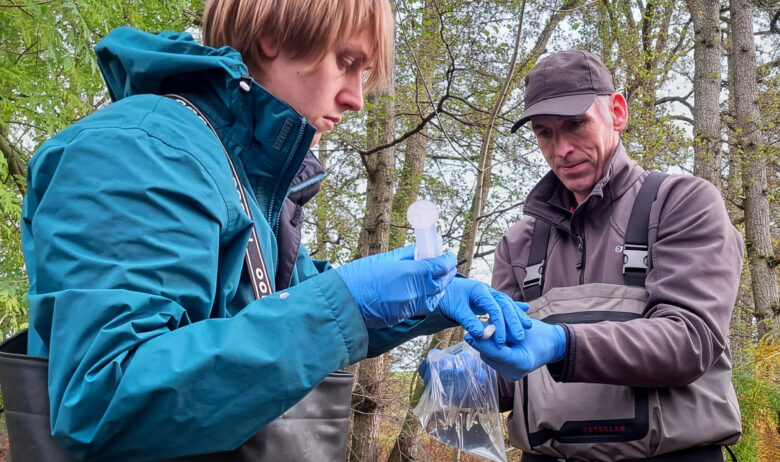
Two men are in outdoors clothes and waders. They are wearing blue latex gloves. One has a syringe in his hand and the other a clear plastic bag containing water and a vial.

The Upper Eden catchment, within the North Pennines National Landscape, is a nationally important stronghold for Water vole and White-clawed crayfish, both threatened in the UK. Historical survey coverage in this area is limited, leaving key data gaps.

American mink, an invasive predator, poses a significant threat to these species. Eden Rivers Trust (ERT) is a partner in the Cumbria Mink Eradication Strategy and we are expanding our successful Lower Eden trapping network into this area to protect native wildlife and reduce impacts on farms.

Thanks to support from the North Pennines National Landscape team through Defra's Farming in Protected Landscapes programme, we have been able to carry out a programme of environmental DNA (eDNA) surveys to establish baseline presence of target species across the catchment. This cost-effective approach will inform long-term conservation priorities and guide targeted mink control.

We published a report of our findings in May 2026. Click on the button to read the full report.

Challenge

The North Pennines Fellside is a wild, remote place with lots of becks that spring out of the fells. Physical surveys are time-consuming and resource-intensive. 

With only a small team, we needed a new approach to confirm anecdotal reports of populations in this area.

Approach

To use environmental DNA (eDNA) surveying methods to establish baseline presence of three target species across the catchment - two native, one invasive. 

This cost-effective approach will inform long-term conservation priorities and guide targeted mink control.

Job done

During Autumn 2025/Spring 2026, 

99 eDNA samples taken across 19 watercourses

66km of habitat surveyed

25 landowners involved

10 volunteers trained in survey methods, supporting two staff members to collect samples

Tested for 3 key species.

What is eDNA sampling?

Two men are in outdoors clothes and waders. They are wearing blue latex gloves. One has a syringe in his hand and the other a clear plastic bag containing water and a vial.

To cover the vast network of becks and rivers, we're using an innovative survey technique that samples for environmental DNA (eDNA) sampling. This method detects traces of DNA shed by animals into the water through blood, poo, fur or skin cells. This method of sampling doesn’t disturb the river habitat or wildlife as much as traditional survey methods, and is more cost-effective and quicker when sampling large areas such as this.

Stephen Henderson, our Conservation Manager: Habitat and Species, explains how the process works:

“We scoop water into a bag, shake it to mix the DNA, then use a syringe to push it into a tube containing a filter. That filter captures DNA, which we send off for analysis. If DNA from any of the target species is present, it suggests a population may be nearby.”

Alongside DNA sampling, staff and volunteers also carry out quick habitat surveys to assess the suitability of sites for future conservation or reintroduction efforts. Once it has been determined whether there is a potential population in a location, we can conduct more traditional physical surveys to measure the size and health of the population.

We've been using eDNA sampling techniques for a while to test for the presence of American mink, water voles, crayfish plague, White-clawed crayfish and American Signal crayfish. As a small charity working in a large river catchment, this means we can effectively cover a wider area and use our resources wisely.

Key findings

A man in waders is in bending over in a beck to collect water for eDNA sampling
  • White-clawed crayfish were detected at two locations, reaffirming their continued presence in these small becks, although none were recorded in three becks where previously there were reported populations, requiring further investigation.
  • Water vole, an endangered species in the UK, was detected at five watercourses, including some previously unrecorded locations. On the nine watercourses where water voles had previously been recorded but eDNA was not found on this occasion, six tested positive for mink eDNA.
  • American mink, a non-native, invasive predator posing a serious threat to water voles and other native wildlife, was detected at nine watercourses, prompting immediate action with nine new mink traps deployed.

Overall, 27% of samples were positive for at least one target species, with detections recorded across 63% of surveyed watercourses

Supporting conservation action

The findings are already driving conservation action on the ground. Identifying the presence of new populations of water voles and white-clawed crayfish has helped to pinpoint where follow-up physical surveys should be conducted to understand more about the populations suggested by the data and inform future conservation efforts here.

Evidence of mink presence has led to expanded trapping efforts, with multiple landowners agreeing to deploy traps across the area – helping the trust realise their goal of a mink-free Cumbria.

Whilst out in the field, engaging with farmers and land managers has opened up more opportunities to work together, making habitat improvements that create better conditions for water voles and crayfish to thrive in. 

By aligning funding from Defra and its agencies, the trust has supported local farmers to install fencing to create wider riparian buffer zones and install alternative livestock watering solutions. 

The above photo shows new fencing installed along Rake Beck thanks to funding we secured from three sources -  the Environment Agency’s Water Environment Improvement Fund, the Farming in Protected Landscapes programme, and Defra’s Endangered Landscape Capital 

Tim Jacobs, Farming and Nature Officer at the North Pennines National Landscape, explained the benefit for farmers: 

 “We are pleased to have been able to support this Eden Rivers Trust project which has provided a clearer picture of species presence across the Eden catchment’s becks. It has also been invaluable for working more closely with farmers, with a good number already taking action to help remove mink and to improve river bank habitats and water quality. It is hoped that it will also help to inform their future farming and nature opportunities and ambitions.”

Made possible thanks to the North Pennines National Landscape team through Defra's Farming in Protected Landscapes programme.

More Projects