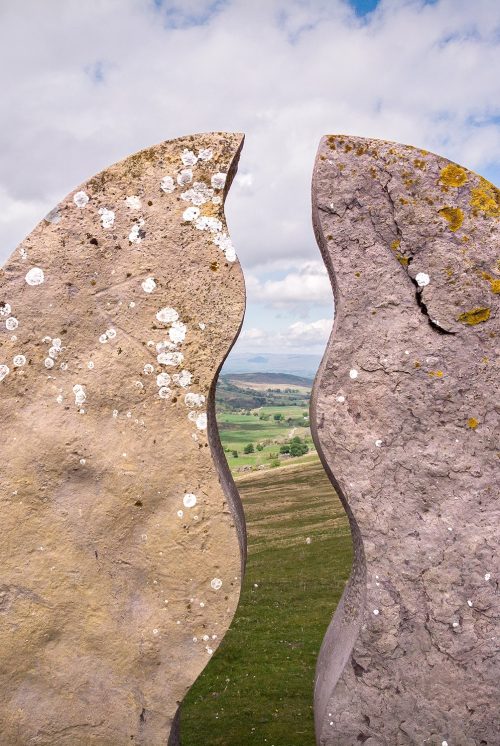
Neolithic standing stone near Shap
The Goggleby Stone is a large standing stone that is one of the few surviving remnants of the Neolithic Shap Stone Avenue.



Neolithic standing stone near Shap
The Goggleby Stone is a large standing stone that is one of the few surviving remnants of the Neolithic Shap Stone Avenue.

For many years it lay fallen on its side, silently marking the passage of time, until it was carefully re‑erected by the County Archaeologist in 1975.
Archaeological excavation revealed how the stone had originally been positioned thousands of years ago. It had been set firmly into clay and wedged upright with smaller stones tightly packed around its base, a testament to the skill and effort of its Neolithic builders. Another stone from the same avenue can still be seen today, lying in the field over to the left.
Shap’s origins go back to Neolithic times, when there was almost certainly an avenue of standing stones here, perhaps 2.5 kilometres in length, forming a sweeping curve along what is now the western side of the village.
Today, only a handful of these stones survive. With a few notable exceptions, most were removed over the centuries.
There were also two standing stone circles. The remains of one of these can be seen from the main road 2.5 kilometres south of Shap village, at the base of the railway embankment. Six huge boulders of Shap granite and several smaller stones are all that remain of what must have been a very impressive monument, destroyed when the railway was built in the middle of the 19th century.
Together, these scattered remains hint at the scale and significance of the ceremonial landscape that once stretched across this area, offering a tangible link to the people who shaped it over 3,000 years ago.